Protect a book without rebinding it: covers, sleeves and storage boxes
You can often reduce wear on a book without replacing its binding. The right choice depends on the problem: a sound paperback rubbing against keys in a bag, a hardback that needs convenient everyday handling, or a damaged volume whose detached pieces must stay together. A removable cover, a transport sleeve and a storage box solve different parts of that problem.
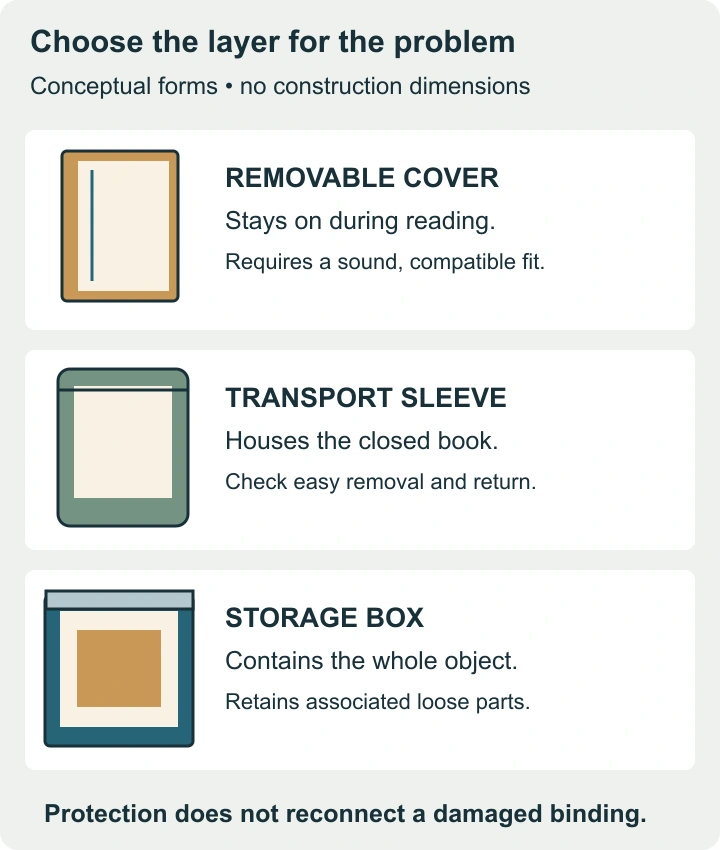
Begin with the book’s condition and normal use. A cover that is comfortable on a modern reading copy may put unwanted strain on a fragile board or joint. The suggestions below help choose a form of protection; they are not instructions for repairing a valuable or unstable binding.
Look at the book before choosing an accessory
With clean hands and a clear surface, inspect the closed book and the opening it naturally permits. Look for loose boards, detached leaves, powdering or flaking surfaces, protruding parts and a cover that no longer closes comfortably. Do not force it flat to find out how far it can open.
The Canadian Conservation Institute recommends suitable enclosures as a way to protect books from light, reduce handling damage and retain loose parts. Its care guidance also emphasizes appropriate handling and storage. An enclosure helps manage exposure; it does not reconnect a broken joint or make a damaged book safe for unrestricted use.
| Situation | Option to consider | Key limitation |
|---|---|---|
| Sound book handled frequently | Well-fitting removable cover | Must not restrict opening or pull on the boards |
| Closed book carried in a mixed bag | Separate sleeve or protective compartment | Removal and reinsertion become part of every reading session |
| Book mainly kept on a shelf | Suitable fitted enclosure | Needs shelf space and a clear identification label |
| Loose or fragile components | Supportive housing and a conservator’s assessment | Housing contains damage; it does not repair it |
A removable cover should follow the book’s movement
A removable cover stays with the book during reading. Its pockets or flaps hold the existing boards, so fit must be evaluated both closed and open. A cover that slides onto the book can still be unsuitable if it stretches across the spine or makes the boards spring outward.
For a sound, replaceable reading copy, try ordinary actions: open to the beginning, middle and end; hold the book as you usually read; close it with the bookmark in place. Watch whether the cover shifts, pulls a board or presses a closure into the page edges. Stop if fitting requires force.
Consider a fictional student who uses a 600-page reference book with removable tabs. A tidy cover that fits the bare book may catch the tabs whenever it closes. The useful specification is the book in its working state, including the tabs and bookmark. If those additions make the closure awkward, choose another arrangement rather than compressing them into a nominally correct size.
Decorative leather is an exterior choice, not proof of conservation suitability. Ask what material actually touches the original cover, whether dyes or finishes can transfer, and how the accessory behaves with repeated use. Avoid applying adhesive tape or improvised treatments to the original book to make an accessory fit.
A sleeve separates the closed book from the rest of the bag
A sleeve or pouch is useful when the main problem occurs during transport. It can keep small hard objects away from the book and make the book easier to remove as one unit. The trade-off is that the book leaves its protection whenever you read it.
In a hypothetical commuter’s kit, the paperback is sound, but a charger and keys share the main compartment. Start by giving the book its own compartment or sleeve and moving the hard items into a separate pocket. A heavier accessory is not automatically better if the separation itself solves the rubbing problem.
Check the opening as well as the interior. The book should come out without scraping its corners along a tight zipper or requiring a grip on the top of its spine. Test the sleeve with the bag loaded, because neighboring objects can compress an otherwise comfortable opening.
Do not infer waterproof or impact-rated performance from soft padding or a water-resistant-looking surface. If liquid protection is a genuine requirement, obtain an explicit specification for the complete enclosure, including its closure. Keep drinks separate wherever practical; an attractive sleeve should not become the reason to accept avoidable exposure.
A fitted box prioritizes storage and containment
A storage enclosure surrounds the whole volume and can keep associated loose pieces together. The Canadian Conservation Institute’s enclosure guidance stresses appropriate materials and fit. A box should support safe handling without squeezing the object or leaving so much space that it moves excessively.
A slipcase leaves part of the book exposed and normally requires sliding it in and out. A drop-spine or clamshell-style box opens around the book. These handling differences matter more than the name alone: a fragile surface that would rub during withdrawal calls for a different approach from a sound book used frequently.
For an inherited volume with a detached board, the immediate goal is containment and reduced handling. Keep the board associated with the book, record the condition and seek appropriate conservation advice before selecting close-fitting support or attempting repair. A decorative cover that makes the volume look complete can conceal the damage while still allowing movement at the broken joint.
Choose the housing materials for the actual object. “Acid-free” is useful information but does not describe every property of an enclosure, its adhesives or its lining. CCI distinguishes neutral-pH materials from materials with an alkaline reserve, and notes that some paper objects need unbuffered housing. Books with unusual components or attached materials may need more specific advice than an ordinary modern volume.
Make a fitting brief that describes use and condition
| Record | Example entry | Why it matters |
|---|---|---|
| Object measured | Closed book with its normal jacket and bookmark | A bare-book dimension may omit what must fit |
| Condition | Sound boards; no loose leaves; one projecting tab | Identifies handling constraints |
| Use | Daily commute, then reading at a desk | Separates transport protection from reading support |
| Access | Remove without pulling the spine or bending corners | Defines a real acceptance check |
| Materials | Supplier to identify contact surfaces and closures | Avoids judging only the outer appearance |
| Storage | Enclosure must fit the assigned shelf without pressure | Checks the complete arrangement |
- Use measured outside dimensions of the object, not only a publisher’s nominal trim size.
- State the units and include the thickest or most projecting part that the enclosure must accommodate.
- Ask the maker to choose construction allowances; an extra number added to every dimension is not a universal fitting rule.
If the object is fragile, arrange measurement and fitting in a way that does not repeatedly manipulate it. A condition photograph and a clear brief can reduce unnecessary handling, but they cannot establish every three-dimensional fit detail.
Protection must still work during ordinary handling
Design a repeatable removal and return routine. For a sleeve, place the book on a clear surface before retrieving other objects. For a box, make sure there is room to open it fully and identify where the lid or flaps will go. Label the enclosure so the book does not need to be removed simply to identify it.
After initial use, inspect the contact points: corners, joints, closure positions and the lining. New rubbing, color transfer or a change in how the book closes is a reason to stop and reassess. Keep the original book accessible for inspection instead of hiding it permanently behind an accessory.
The useful choice is the one that reduces the book’s actual exposure while making safe handling easy. For a daily reading copy that may be a simple sleeve. For a fragile family volume it may be a fitted box and limited handling. Neither requires pretending that a protective accessory has repaired the binding.