Compare leather bags with the same load and a clear decision rule
The useful comparison between two leather bags starts with the same contents and the same journey. Otherwise, a lighter load, a different packing arrangement or a more favorable demonstration can make one design appear better for reasons unrelated to the bag itself.
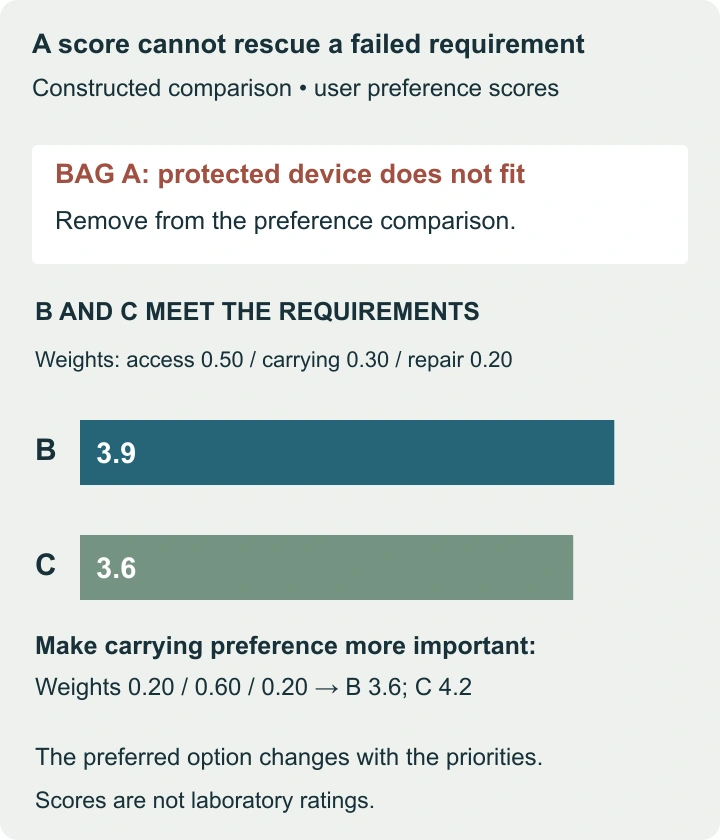
Begin with essential requirements, then compare preferences among the bags that meet them. A weighted score can help organize those preferences, but it should never allow attractive leather or convenient pockets to compensate for a laptop that will not fit.
What the historical category tells us
The saved 2005 Renaissance Art category page was titled “Rustic Leather Bags” and grouped satchels and totes. It establishes a historical product category. Its promotional durability language does not establish a present warranty, a tested load rating or the condition of any bag encountered today.
This guide therefore concentrates on a repeatable assessment. It does not rank current products, reproduce old prices or claim that a material name predicts a number of years of service.
Set non-negotiable requirements before assigning scores
Write a packing list with the actual objects, including cases and items easily forgotten in a demonstration. A computer inside its ordinary sleeve is a different fitting object from a bare computer. A bag that closes with the device alone may fail once the charger and notebook are included.
| Question | Type of decision | Example evidence |
|---|---|---|
| Does the protected device enter and leave normally? | Essential requirement | A trial with the actual device or a faithful dimensional substitute |
| Does the bag close with the required load? | Essential requirement | Closure without forcing or unacceptable pressure |
| Are necessary items accessible? | Requirement or preference, depending on the task | A realistic retrieval sequence |
| Which arrangement feels better to carry? | Personal preference within suitable options | A supported trial with equal contents |
| Is a repair route available? | Preference or essential requirement | Specific information about parts, access and service |
Record an unknown as unknown. “The strap is probably replaceable” should not receive the same confidence as a documented replacement method. If the missing information concerns a requirement, obtain it before treating the option as suitable.
Compare loaded mass, not just the empty bag
Suppose a fictional Bag B weighs 1.2 kg empty and Bag C weighs 0.8 kg. Both carry an identical 3.8 kg kit. Their loaded masses are 5.0 kg and 4.6 kg respectively. The difference is 0.4 kg.
Bag C is about 33.3% lighter than B when comparing the empty bags: 0.4 ÷ 1.2. But the loaded system is only 8% lighter: 0.4 ÷ 5.0. Both statements are mathematically correct; they describe different denominators. The loaded comparison is more relevant to what the user actually carries.
Mass is not a complete comfort assessment. Strap shape, adjustment, bag position, walking duration and the person using it also matter. These figures are not safe-load limits or medical advice. If a load produces discomfort, revise the load or carrying arrangement rather than assuming that a material or wider strap makes it acceptable.
Use the same short sequence for each candidate
- Pack the required kit, close the bag, adjust it for ordinary use and retrieve the most frequently needed items.
- Try the normal transition from carrying to a supported surface and back.
A desk-only inspection cannot reveal whether the strap adjustment is inconvenient during the journey.
Observe the load path: where the handles or strap attach, how the surrounding material behaves and whether contents press against a seam or closure. A neat stitch line is useful to inspect, but it does not establish seam strength or a certified capacity. Do not conduct improvised overload or drop tests with valuable contents.
Look for functional issues in the particular object: partly detached hardware, torn attachment areas, sharp edges or a closure that will not work normally. An attractive finish should not distract from a visible problem that needs assessment.
A worked scorecard, after the requirements are satisfied
In the following fictional comparison, Bag A fails the protected-device fit requirement and is removed from consideration. B and C pass the requirements. The user then scores access, carrying preference and repair options from 1 to 5, where a higher score means a better match to that user’s stated priorities. These are illustrative judgments, not measured product ratings.
| Criterion | Weight | Bag B | Bag C |
|---|---|---|---|
| Access | 0.50 | 4 | 3 |
| Carrying preference | 0.30 | 3 | 5 |
| Repair options | 0.20 | 5 | 3 |
| Weighted total | 1.00 | 3.9 | 3.6 |
B’s total is 0.50 × 4 + 0.30 × 3 + 0.20 × 5 = 3.9. C’s is 3.6. That result expresses this set of preferences. It does not prove that B is objectively superior or that the difference of 0.3 is scientifically significant.
Now change the weights to 0.20 for access, 0.60 for carrying preference and 0.20 for repair. B scores 3.6 and C scores 4.2. The preferred option changes. This sensitivity check is useful because it exposes a real tradeoff instead of hiding it behind a single total.
Ask what a material claim actually supports
A description of leather, thread or finish may identify components. It does not automatically establish performance of the assembled bag. Water can enter through openings or seams; hard objects can create local pressure; an attachment can fail even if the broad leather panel remains intact.
If a seller claims water resistance, load capacity or a particular service life, ask what the claim covers and how it was established. Distinguish a test of a material sample from a test of a complete product. Avoid converting an appealing phrase such as “built for generations” into an expected lifespan in your comparison.
Evaluate repair access and care as practical constraints
Ask which parts are replaceable and how a repairer would reach the attachment. A rivet hidden behind a lining, a stitched-in strap and a removable fitting present different service questions. The presence of repairable-looking parts is not proof that a suitable service is available.
Care also depends on the object. The National Park Service’s conservation guidance describes long-term problems associated with dressings on historic leather, while distinguishing museum preservation from continued use of working objects. Do not turn either context into a blanket instruction to oil every bag or never maintain any modern leather.
For a current working bag, obtain care instructions appropriate to its material and finish. For a valuable old object, seek conservation advice before applying a treatment. A maintenance plan should be specific enough to follow, not a collection of household recipes.
Keep the reason for the choice visible
Finish with a sentence such as: “B meets the required fit, and its easier access matters more for this route; C remains preferable if the carrying portion becomes longer.” That statement preserves the tradeoff and the conditions under which the choice could change.
The bag comparison sheet records the common load, requirements and observations. For a more detailed packing sequence, use the laptop-satchel guide. If an existing design cannot meet the requirements, the custom laptop-bag brief helps turn the missing features into measurable questions.
A fair comparison leaves the required load unchanged, keeps unsupported claims out of the score and explains why the chosen tradeoff suits the person using the bag. That remains useful even when the shortlist or daily routine changes.