Choose a leather journal by planning the pages you will actually use
A leather journal is useful when its pages match the work you want to keep. Daily reflection, project notes, sketches and reference records ask different things of a notebook. Before choosing the cover, decide how much you will write, how you will find it again and what should happen to the book when it is full.
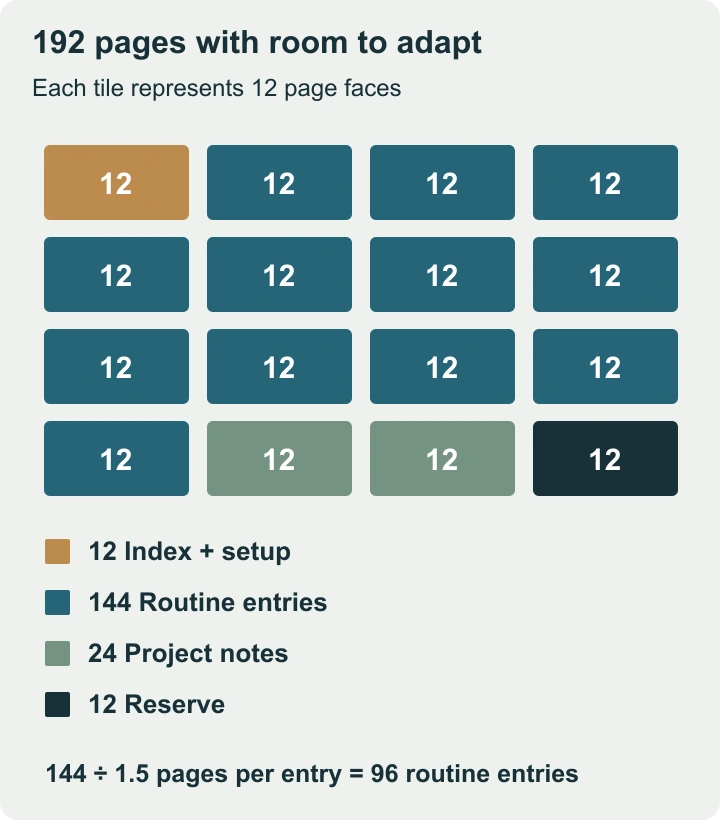
The following method builds a fictional 192-page writing journal. Its numbers are planning assumptions, not a specification for a Renaissance Art product. The same approach works with other page counts and with either a permanently bound journal or a notebook inside a reusable cover.
Choose a main job for the journal
Start with one sentence: “This book will help me…” Complete it with a task rather than an aesthetic preference. Examples include keeping a daily record, following a research project or recording decisions from client meetings. A beautiful cover cannot resolve an unclear filing system.
| Main use | What a page needs to hold | What retrieval requires |
|---|---|---|
| Daily narrative | Dated entries of varying length | A date range and occasional subject references |
| Project work | Questions, decisions, sketches and next actions | Project names and cross-references between entries |
| Meetings | Participants, decisions, owners and due dates | A way to distinguish an agreed action from a passing idea |
| Reference collection | Information expected to remain useful | An index and a way to mark superseded information |
Mixed use can work, but it should be intentional. If daily entries and project notes share the same sequence, an index can connect them. If confidential meeting notes travel with a personal diary, decide whether keeping them together is appropriate before relying on the convenience of one book.
Estimate capacity from actual writing
Take three ordinary entries or make three trial entries on comparable paper. Count the page faces used, including diagrams and spacing. A sample that compresses your handwriting to fit a desired book size will underestimate the space needed in real use.
In this guide, a page means one writable face. A leaf has two faces, but blank endpapers, printed introductory pages and unusable surfaces may not contribute to your available writing area. Check the actual book rather than assuming that every advertised page can be allocated.
Suppose the fictional 192-page journal has 180 pages available after 12 pages are set aside for an index and setup. Using all 180 at an average of 1.5 pages per entry would permit 120 entries. That is a capacity estimate, not necessarily 120 days: some days may have several entries and others none.
Reserve room for the work that arrives later
| Purpose | Pages | Reason for the allocation |
|---|---|---|
| Index and setup | 12 | Identify the volume and create a retrieval structure |
| Routine entries | 144 | The main writing task |
| Project notes | 24 | Longer material that does not fit the usual entry |
| Reserve | 12 | Unexpected expansion, continuation notes or corrections |
| Total | 192 | All page faces accounted for |
At 1.5 pages per routine entry, the 144-page allocation gives room for 96 entries. If ordinary entries use two pages instead, capacity falls to 72 entries. That difference is a reason to sample your writing rather than choosing a page count by appearance.
The allocation need not create rigid physical sections. You can reserve capacity conceptually and write sequentially, using the index to distinguish projects. This avoids leaving a large unused section while another fills early. If you prefer fixed sections, leave a clear continuation reference when a topic outgrows its space.
Use a small indexing system you will maintain
Number pages if the notebook does not already do so. Give each entry a date and a short heading. When a topic deserves retrieval, add it to the index using the same wording each time. Consistent labels are more useful than an elaborate code you stop using.
For example, an index entry might read “Kitchen project: measurements 18–21; supplier questions 47; final decision 83.” The page at 83 can refer back to 18–21 rather than copying the measurements again. If a measurement changes, mark the earlier value as superseded and point to the correction so a later reader does not treat both as current.
For a meeting record, distinguish “decision,” “action” and “question.” “Ask about delivery” is not the same as “Delivery agreed for Tuesday.” Add an owner and date only when they were actually agreed. The notebook should preserve the state of knowledge at the time, including uncertainty.
Evaluate the page with the tools you intend to use
- Use the usual pen, pencil or other medium on the actual paper stock where a trial is allowed.
- Check the front, the reverse and the facing page after an ordinary closing interval.
- Notice whether the result makes both sides usable for your purposes.
A paper-weight number alone cannot settle that practical question.
Keep the trial representative. If you normally underline with a second pen or make small shaded sketches, include those actions. If ink requires a pause before closing, decide whether that pause is compatible with your routine. Do not turn a paper test into a product claim unless the material and conditions are known.
For more detailed comparisons of the page itself, use the notebook paper and writing trial. If the main purpose is art, the art-journal guide considers medium-specific needs. The purpose here is to choose a workable journal system, not to rank every paper.
Choose between a bound object and a reusable cover
A permanently bound journal keeps the cover and its contents together. A removable cover can move to a new notebook, while the completed refill becomes a separate object to label and store. Neither arrangement is automatically more durable or more economical over an unknown period.
Consider the completed object, not only the new purchase. Will a refill still have a stable cover after removal? Can it be identified on a shelf? Will you need to keep loose material separately? If the book matters as a lasting record, those questions may outweigh the appeal of reusing an attractive outer cover.
Canadian Conservation Institute guidance emphasizes supporting a book and respecting its opening characteristics. If the binding resists the position needed for comfortable writing, choose a different format or suitable support instead of forcing the joint. An outer leather cover does not change the binding into a different construction.
Run a short trial before committing to a complicated system
Use a few ordinary working sessions to test the proposed headings, entry length and indexing method. This is a personal usability trial, not a scientific study. Record where the system helps and where it creates extra work.
A useful observation might be: “The two-page meeting layout leaves enough room, but copying every action into the index is slow.” The revision could be to index only the meeting heading and keep actions on the original page. Another observation might be that fixed project sections waste space; sequential entries with cross-references may solve that problem.
The journal planning sheet combines the page budget and trial notes. Adjust its assumptions to the actual notebook. A system that survives an ordinary busy day is more valuable than one that looks complete only in a sample spread.
Finish the volume with a clear identity
Before moving on, add the date range and a short description of the contents. Complete the useful index entries, identify loose items and note where any continuation begins. Keep a sensitive record in an appropriate place rather than assuming a closed cover provides privacy.
If selected pages are digitized, retain their page numbers and volume identity so the images remain understandable outside the book. Avoid pressing a resistant binding flat for a scan. A leather journal succeeds as a record when its contents remain readable, findable and attributable—not merely when every page has been filled.