How to measure a book for a removable leather cover
To order a removable leather book cover, measure the actual book closed and resting naturally: its outside height, the width of each cover board and its thickness. Then record anything that changes its shape or access requirements, including tabs, an elastic band, a rear pocket and the inserts you normally carry. These are the book’s dimensions. They are not the dimensions of a finished leather cutting pattern.
This guide is for a removable sleeve-style cover fitted around a sound everyday book or notebook. A loose board, split hinge or brittle binding changes the task: fitting a tight outer cover can make handling harder, and it does not repair the underlying damage. Have a valuable or fragile book assessed before attempting a fitting.
Make a measurement record the maker can interpret
Use one unit throughout; millimetres avoid mixing fractions of an inch with decimal centimetres. Place the book on a flat surface and use a ruler or another measuring tool without squeezing the binding. Take each reading again after repositioning the tool. If the readings differ, record the range and explain where the difference occurs instead of averaging away an irregular shape.
| Field | How to record it | Common source of confusion |
|---|---|---|
| Height, H | Measure the outside book cover from its top edge to its bottom edge. | The paper block may be shorter than the boards. State which part you measured. |
| Front width, Wf | Record the closed front cover’s outside width from the spine side to the fore-edge, the opening edge opposite the spine. | A curved spine makes the starting point ambiguous. Include a photograph and follow the maker’s chosen reference points. |
| Back width, Wb | Measure the back cover separately if it differs from the front. | Assuming equal boards can hide an unusual binding or a projecting back cover. |
| Thickness, T | Measure the closed assembly without compression. Note thickness near the spine and at the fore-edge if different. | Loose inserts can create a wedge shape. A single “spine thickness” does not describe it fully. |
| Projections | Record how far tabs, loops, clasps or other fittings extend and where they sit. | Including a tab in the main width without identifying it conceals the actual board size. |
| Ordinary loaded state | Repeat relevant dimensions with the contents you genuinely carry. | An empty notebook measurement can understate the working size. |
A photograph should show the ruler in the same plane as the edge being measured, with its zero and the far edge visible. A picture taken at a steep angle can make the reading unclear. For a rounded spine, send a view from above the closed book as well as the front view; the maker may ask for an additional flexible measurement around its outside contour.
Worked example: turn measurements into a usable brief
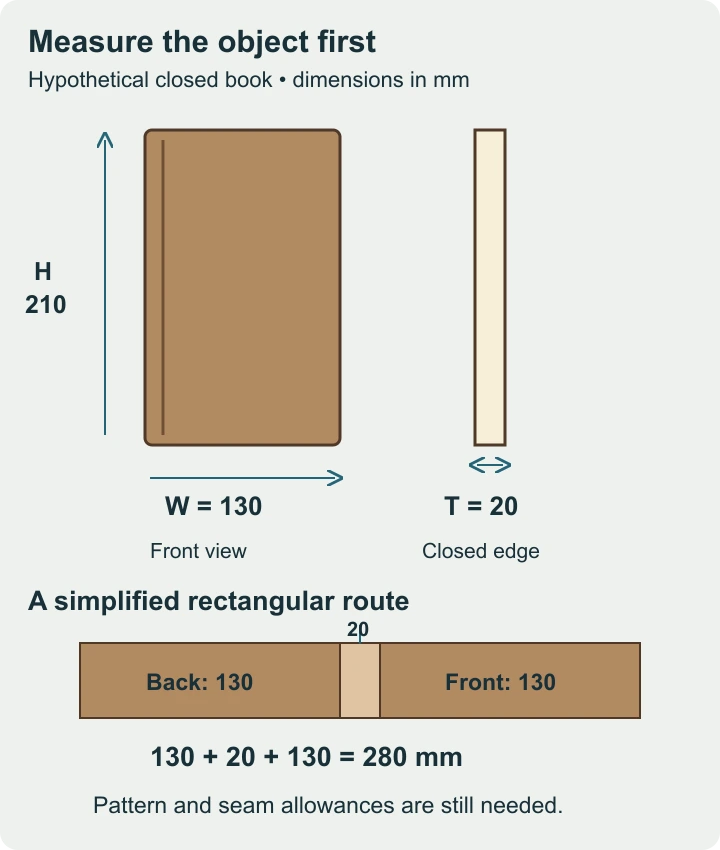
Consider a hypothetical hard-cover notebook with equal 130 mm-wide boards, a height of 210 mm and a closed thickness of 20 mm. Its owner carries two folded sheets in the rear pocket. With those sheets inserted, the fore-edge thickness measures 23 mm while the spine remains approximately 20 mm. There is also an index tab projecting 6 mm beyond the fore-edge.
The correct brief does not simply say “130 × 210 × 23 mm.” That loses the distinction between the board, the thickened fore-edge and the tab. Use a small record like this:
| Item | Recorded value or observation |
|---|---|
| Outside boards | H 210 mm; Wf 130 mm; Wb 130 mm |
| Empty closed thickness | Approximately 20 mm at spine and fore-edge |
| Normal contents | Two folded sheets in the rear pocket; no other loose inserts |
| Loaded thickness | Approximately 20 mm at spine; 23 mm at fore-edge |
| Projection | One index tab extends 6 mm at the fore-edge; position shown in a photograph |
| Required access | Rear pocket, ribbon bookmark and tab must remain usable |
| Construction to confirm | Sleeve engagement, usable internal size, flap reach and closure with the normal load |
The maker can now distinguish a book that is uniformly 23 mm thick from one that opens into a wedge because of inserts. Do not round the dimensions up and call the difference an allowance. Supply the readings as taken, and let the maker identify the allowance separately.
What the familiar 2W + T calculation can tell you
For a simplified rectangular closed book with equal cover widths, the route across the back, spine and front is 2 × W + T. In the unloaded example, that is 130 + 20 + 130 = 280 mm. With unequal covers, use Wb + T + Wf for the same simplified calculation.
This is a useful scale check. It tells you immediately that a proposed 250 mm outside span cannot follow that 280 mm rectangular route. It does not tell you to cut a 280 mm-wide piece of leather. The leather’s own thickness, curved turns, the shape of the book’s joints, sleeve construction, stitching and the closure all need to be resolved in the pattern.
| Quantity | Can the owner supply it? | What it does not establish |
|---|---|---|
| 210 mm outside height | Yes, as a measurement of the example book. | Finished leather height or stitching clearance. |
| 280 mm simplified route | Yes, as arithmetic from stated rectangular dimensions. | The actual outside contour of a rounded binding. |
| Leather cutting width | Only if making and validating the pattern personally. | It cannot be inferred from the three book measurements alone. |
| Usable internal fit | The maker should confirm it for the finished construction. | An external product dimension does not describe the free space inside its seams. |
For example, a hypothetical sleeve with an external height of 216 mm and 4 mm-wide unusable bands at both the top and bottom would leave only 208 mm between those bands. A 210 mm book would not fit that simplified opening, even though the outside height looks generous. Real seam shapes differ; this example explains why “outside size” and “usable size” must be separate fields.
The cover-route calculator performs the equal-width arithmetic. Use the measurement worksheet to record the details it deliberately leaves out.
Check the sleeve pockets and the opening movement
In a sleeve-style cover, pockets hold part of the book’s front and back covers. Their depth changes how much of each board is captured. Too little engagement may let a board slip out; a pocket that extends into a moving joint or obstructs an inner pocket may interfere with use. There is no universal pocket depth that solves both problems for every binding.
Ask the maker how the book is inserted. Some constructions require a particular sequence or a degree of cover flexing. A flexible notebook and a stiff hardback may behave very differently during that step. If fitting requires a book board to bend visibly or a hinge to be pulled hard, stop and clarify the method.
The Canadian Conservation Institute advises respecting a binding’s opening limits rather than forcing a book flat. Use that principle when comparing the uncovered and covered book: the new cover should not require you to defeat the original binding to reach a page. Support a reluctant opening instead of pressing it down.
Use a paper mock-up for layout, then a real fitting for behaviour
A paper model helps you locate sleeve folds, a flap and a pen loop before committing to material. Make it around a sound everyday notebook or a dimensionally similar dummy, without taping anything to the book. Mark the front, back, spine and intended pocket edges so that a fold is not mistaken for a cutting line.
Use the mock-up to answer spatial questions: does the flap cover the place where your hand rests; will a pen sit beside a tab; can you still reach the rear pocket? Do not use it to certify leather fit. Paper has different thickness and bending behaviour, and a taped fold does not reproduce a sewn leather seam.
For an expensive custom cover, ask how the maker validates the pattern. That might mean fitting the actual book, using a matching model, or checking a prototype against the measurements and photographs. Agree who resolves a mismatch before cutting or personalization makes the work harder to change.
Diagnose a tight fit before changing anything
| Symptom | Possible explanation | Next check |
|---|---|---|
| The boards enter only if bent. | The insertion method or sleeve opening may be unsuitable. | Confirm the intended insertion sequence and usable opening dimensions. |
| The book closes empty but not with normal inserts. | The loaded shape was not allowed for. | Compare spine and fore-edge thickness with the original measurement record. |
| The covers lift or the hinges pull when opened. | The outer route or pocket position may restrict movement. | Compare the same page opening with and without the removable cover. |
| One board slides out during ordinary use. | The fit may be loose, engagement shallow or the notebook shape unsuitable. | Check both sleeve depths and whether the notebook has shifted sideways. |
| The fastener reaches only under tension. | Flap reach, loaded thickness or pen placement may be wrong. | Try the normal load with the pen removed, then identify which dimension changes the result. |
These are diagnostic possibilities, not instructions to trim a pocket or stretch the leather yourself. Record the symptom and its conditions. “The back board rises when I open near page 10, but not at the middle” gives the maker something specific to investigate.
Approve the fit in its working state
Check the finished cover on a clean surface.
- Confirm that the book can be inserted and removed as intended, that both boards remain seated, and that the cover closes with the ordinary contents in place.
- Try openings near the beginning and end as well as at the centre.
- Reach the bookmark, tabs, elastic and rear pocket.
- Finally, carry the assembled book in its normal compartment.
Record which book was used for that approval. A later replacement may share the same height and width but have a thicker paper block or a softer cover. Recheck the fit when changing models rather than treating the original approval as a universal size guarantee.
What changes for dust jackets, soft covers and older books?
Should I measure with the dust jacket on?
Measure the arrangement you intend to use, but tell the maker that a jacket is present. Its folds and flaps may interfere with the sleeves, and slipping it in and out can damage it. For a valuable jacket, agree a storage and handling approach instead of assuming it belongs inside a tight removable cover.
Can I squeeze a soft-cover book to get a cleaner reading?
No. Record its natural closed shape and mention that its covers flex. A compressed measurement may describe a size the book will not maintain during use. If the edges curl, show that in the photographs.
Will a leather sleeve preserve a damaged old binding?
It is not a conservation treatment. A fragile volume may need a suitable enclosure and professional advice rather than a fitted accessory. The Canadian Conservation Institute also cautions against leather dressings on historic bindings; adding oil to make a damaged cover slide into a sleeve is not an appropriate fitting method.