Choose a snap-closure notebook cover that aligns and opens comfortably
A snap closure is convenient when the two parts meet naturally and can be released without making the notebook or leather do unnecessary work. Its usefulness depends on alignment, the thickness of the contents, the position of the hardware and the way you hold it. A loud click alone does not establish a good fit.
Mike Shea’s October 2005 account identifies a snap-closure version among Renaissance Art’s historical notebook covers. That confirms the design category, not current stock, hardware specifications or performance of a cover available today. The following checks apply to the actual object in front of you.
Inspect the whole fastening, including its attachment
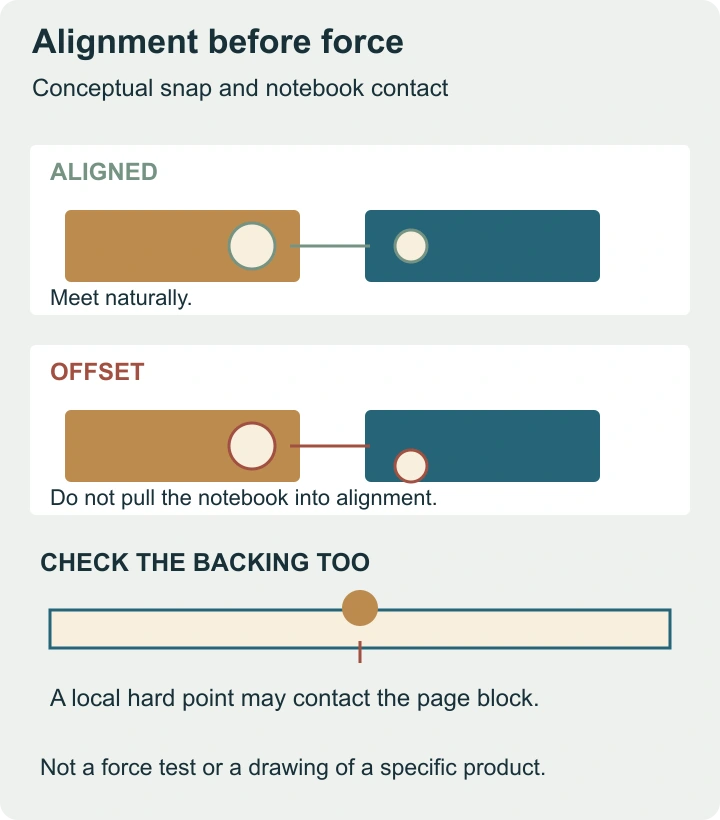
A snap has mating components and attachment points. Look at both sides of the flap and the receiving area. Identify any hard backing that could contact the notebook, any visible distortion around the attachment and whether the parts sit squarely when brought together.
Fastener manufacturer YKK notes that attachment conditions can affect snap performance and that excessive pressure can deform or damage fasteners. Its guidance concerns its own components and applications; it does not identify the hardware used in a historical Renaissance Art cover. The practical lesson is to assess the attachment and surrounding material as well as the fastener itself.
Do not turn an inspection into a destructive test. A loose, sharp, distorted or partly detached component is a reason to stop using that closure and seek appropriate repair advice. Repeatedly forcing it to prove that it still works can make a limited problem worse.
Bring the parts together before pressing
- With the intended notebook seated, guide the flap into its natural position.
- Check whether the mating parts align without pulling the board sideways or compressing the page block.
If they meet only when the book bows, the closure is being asked to overcome a fit problem.
| Observation | Possible issue to investigate | Next check |
|---|---|---|
| The parts meet without pulling | Alignment is plausible in this condition | Check opening and writing with the same contents |
| The flap must be pulled sideways | Uneven seating, contents or construction | Recheck board position before closing again |
| The board bends as the parts meet | Too much load or insufficient closure reach | Remove optional inserts and compare the result |
| The snap rotates or lifts at its attachment | Attachment or surrounding-material problem | Stop the trial and ask for an assessment |
These are observations and possible explanations, not diagnoses of a particular product. A closure can be awkward for more than one reason. Change one condition at a time so that a useful result is not lost among several simultaneous adjustments.
Use a condition matrix instead of an empty-book demonstration
In a fictional trial, a cover works with a fresh notebook but becomes difficult after folded papers are added. The owner also keeps a pen in an attached loop. It is tempting to assume the snap itself is too stiff, yet the problem may be the load or the pen’s position.
| Condition | Illustrative observation | What the observation suggests checking |
|---|---|---|
| Notebook only | Flap aligns and opens comfortably | A useful baseline |
| Notebook plus ordinary papers | Flap pulls the front board inward | Whether the added thickness is compatible |
| Notebook plus pen, no papers | Pen cap touches the closure path | Loop position and actual pen dimensions |
| Notebook, papers and pen | Two obstructions occur together | Both earlier issues, not a stronger snap |
The observations in this table are invented to illustrate the method. They are not test results for Renaissance Art. A real record should describe what happened, including when no problem was observed, rather than copy the example outcomes.
Decide which contents are essential. If the pen must remain attached, it belongs in the acceptance test. If the papers are a temporary accumulation, moving them may solve the problem without changing the cover. A stronger closure is not necessarily an improvement when the object inside is already being compressed.
Check whether the release motion suits your hands
Open the closure using the intended grip and direction, following any instructions supplied with the actual product. Support the nearby material so that an ordinary release does not become a long pull on the whole flap. If operation requires a painful grip, fingernail leverage or twisting the notebook, the design may be unsuitable for you even when it is not defective.
Repeat the ordinary motion a few times only as a usability check. This is not a cycle-life test and cannot justify a durability claim. Do not deliberately apply extra force, use tools to pry the parts apart or bend hardware to alter the action.
A one-handed opening demonstration should reflect a real situation. Holding a notebook above a hard floor while testing an unfamiliar release adds a drop risk without answering the question better. Use a supported surface and assess whether one-handed access is actually necessary for your routine.
Locate the hard point when writing and carrying
Open the notebook near the front and rear and write with your usual hand position. Notice whether the snap, its backing or the folded flap lies beneath the wrist or a thin stack of pages. Move the flap only within the design’s normal range; repeatedly making a sharp crease is not a neutral adjustment.
Then consider the closed notebook in its normal bag compartment. A hard component pressed against another delicate object can create a contact point. A separate pocket or a different orientation may prevent that contact, but do not assume soft leather automatically isolates all hardware.
The question is local. An outer cover can protect the broad faces while a single protruding fastener remains the first point to touch a neighboring item. Inspect the complete packed arrangement rather than evaluating the notebook on an empty desk alone.
Treat repairability as a question before a failure
Ask whether the fastener can be replaced, who would do the work and whether the surrounding material would need repair. A replacement part with a similar appearance may not match the original dimensions or attachment requirements. Do not assume that every snap is interchangeable.
Document any developing problem with a clear photograph and a description of the condition in which it occurs. “Closes with the notebook alone but pulls the board when the rear pocket is filled” is more useful than “the snap is bad.” Do not apply household oils, glue or improvised modifications as a substitute for identifying the problem.
Choose a closure for the actual opening cycle
A snap may suit frequent access when alignment, hand comfort and hardware position all work. If the closure repeatedly interferes with use, compare the open-sided arrangement or the wrap-and-tie sequence, using the same notebook and contents.
The decision should rest on a complete cycle: retrieve, release, open, write, close and return to the bag. A successful snap makes that sequence uncomplicated while leaving the notebook in its ordinary shape. It does not need to win a contest for the strongest grip or the loudest click.