Choose a notebook by testing the pages you actually need
Choose a notebook by reproducing the work you need it to hold. A meeting page, a study summary and a measured sketch place different demands on the same sheet. Once the notebook works on its own, choose a leather cover that fits it. Reversing that order can leave you with an attractive accessory around a writing book you do not enjoy using.
A useful comparison needs only a few candidates and the same tasks on each. The goal is to discover where information becomes cramped, where the ruling helps and whether yesterday’s note can be found today. There is no single layout that makes every person more organized.
Compare candidates with three representative pages
Prepare a small test pack from ordinary work, removing confidential details. Use a paragraph, a table and a diagram rather than copying three attractive layouts from someone else’s notebook. Keep the content and your handwriting size the same across candidates.
| Page | Include | Look for |
|---|---|---|
| Meeting | Date, purpose, six discussion notes, three actions and their owners. | Whether decisions remain distinguishable from background notes. |
| Study or reference | One idea, an explanation in your own words, a worked example and a source identifier. | Room to connect the explanation with the example without tiny writing. |
| Planning or sketching | A simple diagram, dimensions, two alternatives and a correction. | Whether the ruling supports alignment and whether revisions still make sense. |
Notice what you leave out to make a page look tidy. If every candidate can hold the title but only one has room for the actual decisions, that is useful evidence. If a larger format fits everything but will never travel with you, portability remains an unresolved requirement.
Make the ruling earn its space
Ruled paper provides baselines for continuous writing. Squared paper provides alignment in both directions. Dots suggest a grid more quietly, while plain paper lets you change scale freely. These are layout differences, not evidence that one format improves intelligence, memory or productivity.
Test the actual spacing. A grid that suits compact handwriting may be restrictive for larger writing or detailed annotations. Likewise, dark rules can compete with a faint pencil drawing. Draw a small circle, a diagonal arrow and a short table before deciding that a page designed for text will work for diagrams.
Here is a hypothetical layout calculation. A 130 mm-wide sheet with 10 mm margins on both sides leaves 110 mm. At a 5 mm grid pitch, that is 22 cells across. A three-column table requiring 8 cells for a task, 8 for notes and 6 for an owner already consumes all 22 cells before extra separators. If you need more generous spacing, reduce the fields, use a landscape page or select a wider notebook.
Do not solve every space problem by shrinking the handwriting. A table is useful only if its contents remain readable when you return to it. A short code with a nearby key may work for recurring labels; abbreviating every word in a one-off explanation often makes retrieval harder.
Use size names to identify, then measure
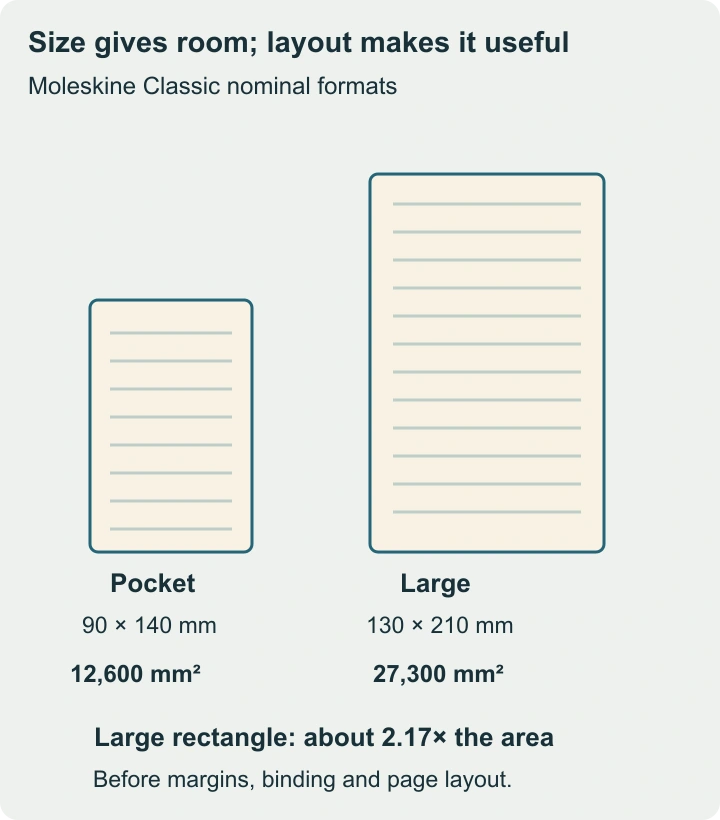
Moleskine lists its Classic Pocket format as 9 × 14 cm and Large as 13 × 21 cm. Those dimensions are useful when making a shortlist. They do not specify every notebook’s thickness, cover stiffness or compatibility with an accessory. Record the exact edition and cover type when ordering a reusable cover.
For an area comparison using those nominal dimensions, 90 × 140 gives 12,600 mm² and 130 × 210 gives 27,300 mm². The larger rectangle has about 2.17 times the area. It will not necessarily hold 2.17 times as much useful information: margins, handwriting, diagrams and binding access affect the usable space.
A “large” notebook and a “large” cover from different makers are not a matched pair merely because the names agree. Measure the closed notebook with its usual inserts, then ask the cover maker to confirm fit. A page-size label is especially weak evidence when the outer boards project beyond the paper.
Test paper and opening separately
Use the intended pen on a sample from the intended stock. Examine line edges, the back of the sheet and any transfer when you turn the page normally. A successful test with one ink does not establish the same result with every ink in your drawer. Keep the sample and its identity if the decision matters.
Then try a bound copy.
- Write near the start and near the end, where the height of the page block under your hand changes.
- Check the inner margin and any rear pocket or elastic you use.
A loose sheet can answer paper questions; it cannot show how the finished book will behave on a crowded desk.
If the sample differs from the notebook being supplied, record that limitation. A display copy may demonstrate the binding style while a paper swatch demonstrates a different stock. Treat them as two pieces of evidence rather than merging them into a test that never occurred.
Choose a retrieval convention before buying extra accessories
Decide how you usually remember a note. If you recall the day of a meeting, dates may be enough. If you repeatedly return to a subject, page references or an index become more useful. The convention should take seconds to maintain during normal use.
| Pattern | Example | What needs maintenance |
|---|---|---|
| Chronological | 2026-11-10 — supplier meeting. | A clear date and heading on each entry; a way to distinguish several entries on the same day. |
| Topic index | Packaging: pages 12, 28 and 47. | Page numbers and a brief index update when a useful entry is made. |
| Project identifier | P07 — delivery checklist, page 47. | A stable project code and a place where its meaning is recorded. |
Consider a meeting note that says “Call Alex.” It is difficult to act on later. “Alex — confirm revised delivery date by Friday; reply goes in project P07” is more useful, provided those are the real agreed details. The notebook layout should leave room for the information that makes an action executable.
Test retrieval the next day. Pick three questions from the notes and try to find their answers without rereading the whole notebook. If you struggle, change the headings or index before adding more coloured tabs. A tab marks a location; it does not explain what is there.
Run a short trial with a defined decision
For example, use a candidate for five ordinary workdays and record a few observations after each day: notes continued because of lack of space, pages left behind because the notebook was inconvenient to carry, and information you could not retrieve. Five days is a suggested trial length, not a research-based threshold or a requirement to write every day.
At the end, distinguish a layout problem from a habit problem. A cramped action column may need more width. Forgetting to bring the notebook may need a different carrying place. Not writing down the decision at all will not be fixed by a heavier cover.
Keep the decision simple: retain the format, adjust one element or choose another notebook. Avoid changing ruling, pen, page size and organization system at once if you want to know which change helped.
Plan the second notebook and the full one
If a reusable leather cover is part of the plan, identify the next refill before committing to a very specific fit. Save the notebook’s exact model, dimensions and normal loaded thickness. A later notebook with the same height and width may still differ in thickness or in the position of its elastic.
When the first notebook fills, label its date range and contents. Give the next one a new identifier so references remain unambiguous. If ongoing work crosses volumes, add a short continuation note at both ends instead of copying every old page.
For mixed uses, separate notebooks only when the separation helps. One notebook can keep everything available; several can isolate projects or protect confidential work. The trade-off is extra carrying and more places to search. Choose the arrangement you can actually maintain.
Turn the trial into a short buying brief
A useful brief might say: “I need room for a weekly task table and handwritten meeting notes, with a grid light enough for pencil diagrams. The book must fit my everyday bag and work with the pen tested on the supplied paper sample. I want a refillable outer cover after the notebook choice is settled.” Add the dimensions and model that passed your trial.
This makes later compromises visible. A smaller candidate may satisfy carrying but fail the table test; a smooth paper may suit ink yet feel wrong for pencil. Choose according to your essential tasks, and keep preferences such as colour or cover finish as separate decisions.