Make a wrap-and-tie notebook cover work through the whole writing session
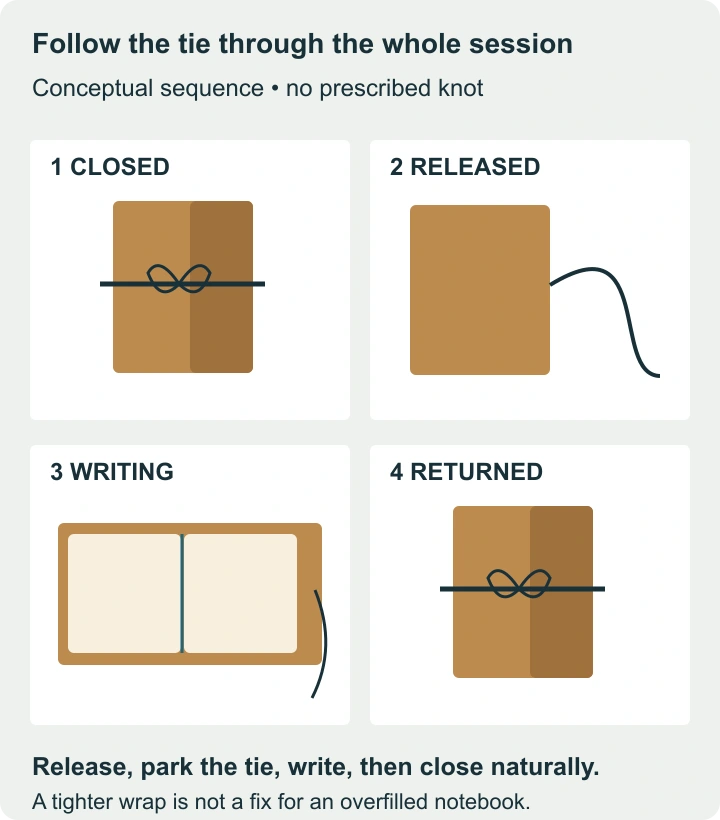
A wrap-and-tie notebook cover should be evaluated as a sequence, not as a closed object. The flap must reach around the ordinary contents, the tie must be manageable when released, and the open cover must leave room for writing. A satisfying closed appearance is only one stage of use.
Mike Shea’s 2005 review records a historical Renaissance Art wrap-and-tie design and his preference for it. That preference belongs to the reviewer. This guide develops a practical trial without borrowing his experience as our own or treating old product details as a present offer.
Walk through the whole opening cycle
- Retrieve the closed notebook. Use its normal storage position and the objects that normally surround it.
- Release the tie. Notice the grip, the direction of movement and where the released length goes.
- Arrange the flap. Keep it clear of the writing area within its natural movement.
- Write an ordinary entry. Include the inner margin and the place where your wrist rests.
- Close the notebook in its usual shape. Return the flap and tie without compressing an overfilled page block.
- Put it away. Check that the tie cannot easily trail into an unwanted contact point.
The sequence reveals details hidden in a product photograph. A tie that looks tidy when closed may sweep across a wet line of ink when released. A flap that seems generous may need more desk space than is available. These are compatibility questions between the object and the routine, not universal faults in the design.
Give the released parts somewhere to go
Measure the usable writing area if space is limited. In a fictional desk setup, the clear width between a keyboard and a lamp base is 450 mm. The notebook and its naturally arranged open cover occupy 470 mm. The difference is 20 mm: the setup cannot be assumed to work unchanged just because the closed notebook fits in the gap.
Possible revisions include moving the keyboard, changing the book’s orientation or choosing a different cover. Folding the flap sharply underneath the page block may create a new pressure point and an unnecessary crease. Test a revision through actual writing, not only through a measurement taken before your hands enter the space.
| Setting | Specific observation | Decision it informs |
|---|---|---|
| Clear home desk | The flap and tie can rest beside the book | Whether the full open footprint is acceptable |
| Small shared table | Released parts enter another person’s space | Whether a different orientation or design is needed |
| Standing note-taking | One hand must support the book and manage the tie | Whether this opening sequence suits the task |
| Bag with exposed hardware | The tie may trail near buckles or zips | How it should be contained when put away |
Check flap reach with the normal contents
Use the notebook with the cards, papers or other additions that are genuinely part of the requirement. A wrap may accommodate some variation, but its reach is finite. Extra thickness changes where the flap rests and how much tie remains available in the intended arrangement.
Do not use a tight tie to force the notebook into a smaller shape. First let the book close naturally. If the boards are bowed or the fore-edge is visibly splayed by inserts, determine whether the contents belong there. An outer wrap should not be used to conceal an overloaded notebook.
There is no universal number of turns or universal tie length suitable for every cover. The attachment location, notebook size, flap overlap and intended fastening method all matter. Follow the instructions for the actual design, and assess whether the remaining ends can be managed comfortably.
Change one part of the routine at a time
Suppose a fictional user finds the cover awkward at a café. They initially blame the tie, but observation shows three separate problems: a small table, an overfilled rear pocket and a pen lying across the flap. Treating all three as “the cover is slow” hides the possible remedies.
| Observed problem | One controlled change | What to record afterward |
|---|---|---|
| Tie crosses the writing area | Place the released length in a clear resting position | Whether it stays clear during an ordinary entry |
| Flap will not reach comfortably | Remove optional accumulated papers | Whether normal closure returns without compression |
| Pen interrupts opening | Move the pen to an appropriate separate location | Whether the opening sequence improves |
| Open cover exceeds the available surface | Try the actual alternative orientation | Whether the hand and page remain supported |
These are possible checks, not guaranteed fixes. If a necessary item must be removed every time the book is opened, that may be evidence that the design does not suit the intended task. Do not redefine the task simply to defend an attractive object.
Inspect the tie where repeated movement occurs
Look at the tie’s attachment, the portions that bend during ordinary use and any place where it rubs against hardware or an edge. Record a developing cut, split, fray or other visible change without assuming that all surface marks indicate the same problem.
If the tie or attachment appears weakened, stop relying on it to secure the notebook and ask about suitable repair or replacement. Do not test its remaining strength by pulling harder. A fastening for keeping a cover closed is not automatically a carrying handle.
For old or significant leather, the Canadian Conservation Institute emphasizes suitable support and avoiding damaging handling. Its collections advice should not be converted into a universal treatment recipe for a modern working cover. An unidentified leather finish is a poor starting point for improvised oils, solvents or heat.
A wrap is not a weather seal
Overlapping leather may shield part of a page edge from incidental contact, but a tie does not establish a continuous seal. Openings, seams and the exposed ends remain relevant. Do not call a cover waterproof on the basis of its material or the number of wraps.
If the journey creates a realistic chance of rain or a leaking container, plan appropriate separation for the notebook. Assess the complete carrying arrangement. The relevant question is how water could reach the paper, not whether the leather looks thick.
Ask about maintenance before assuming it will last indefinitely
Determine whether the tie can be replaced independently and whether the attachment is accessible for repair. Keep any maker-specific care instructions with the object’s record. A replaceable component can be useful, but only if a suitable part and competent repair route actually exist.
Distinguish cosmetic wear from a functional problem. A change in surface appearance may be acceptable to the owner; a tie attachment pulling free is a different matter. Describing both simply as “patina” makes the record less useful.
Let the trial decide the tradeoff
The wrap-and-tie format may work especially well for a deliberate writing session where the full opening sequence is comfortable. Someone who repeatedly makes brief notes in restricted spaces may prefer the open-sided design or an appropriately fitted snap closure.
Use the same notebook, ordinary contents and setting for each comparison. Record the point where one arrangement helps or interferes. A successful wrap-and-tie cover provides a manageable sequence from closed storage to supported writing and back again, without requiring force, improvised folds or a fictional promise of unlimited protection.