Use an open-sided notebook cover without leaving protection to chance
An open-sided notebook cover removes a fastening step and keeps the page edge easy to reach. That can suit repeated short notes or a notebook that lives on a desk. The tradeoff is that some edges remain exposed, so retention inside the cover and protection during transport need to be considered separately.
The open-sided design appears in Mike Shea’s 2005 account of Renaissance Art covers. His review is a historical record of his experience, not a current specification or a test performed for this guide. The checks below help assess a comparable construction with your own notebook and carrying arrangement.
Identify which job each layer performs
The notebook’s own boards and binding support its pages. A removable cover may protect broad surfaces and provide retention pockets. A bag compartment or sleeve may separate the notebook from neighboring objects. None of those functions should be assumed merely because another layer is present.
| Function | What to examine | What not to assume |
|---|---|---|
| Retention | The refill remains seated during ordinary handling | That tight insertion automatically means comfortable use |
| Surface protection | The broad faces avoid direct contact with neighboring objects | That every edge or corner is enclosed |
| Page-edge protection | The exposed top, bottom and fore-edge meet no sharp or abrasive items | That an open side behaves like a sealed pouch |
| Loose-item containment | Cards and papers have an appropriate retained location | That the outer cover captures anything placed between pages |
That last distinction is easy to miss. A cover can hold a notebook securely while a loose receipt slips from the page block. If carrying loose material is essential, it needs its own retention method. Making the outer cover tighter may reduce access without solving the real problem.
Test access in the place where you will use it
For a desk notebook, begin with the book where it normally rests, open to a new entry and write a few lines. For a carried notebook, start with it in the bag. Observe which hand supports it and what must be moved before the first line can be written.
A fictional user makes six short note-taking visits to a notebook each working day. Over five days, that is 30 sessions. A design with a separate fastener would ordinarily add an opening and closing action to each complete session: 60 fastening actions in this constructed routine. The arithmetic explains why access can matter; it does not establish a measured time saving or prove that a fastener is inconvenient.
If the notebook is usually opened once for a long evening session, the same advantage may be less important. Choose the design around the actual frequency and setting, rather than treating “quick access” as a benefit of equal value to every reader.
Check seating through normal movement
- Install the notebook as intended and check that the retaining portions engage the appropriate boards.
- Open and close it gently over a supported surface.
- Notice whether a board gradually walks out of its pocket, whether an edge catches or whether the notebook shifts as your hand changes position.
Do not shake the assembly over a floor or hold it by a vulnerable corner to prove retention. Such a test is unnecessary for assessing ordinary use and may damage the notebook. If the design is supposed to support a particular carrying method, obtain the maker’s instructions for that method.
Repeat the observation near the beginning and end of the book. The balance of the page block changes, which can expose a fit problem hidden at the centre. An open side does not eliminate the need for comfortable binding movement.
A worked packing example: change the neighboring objects
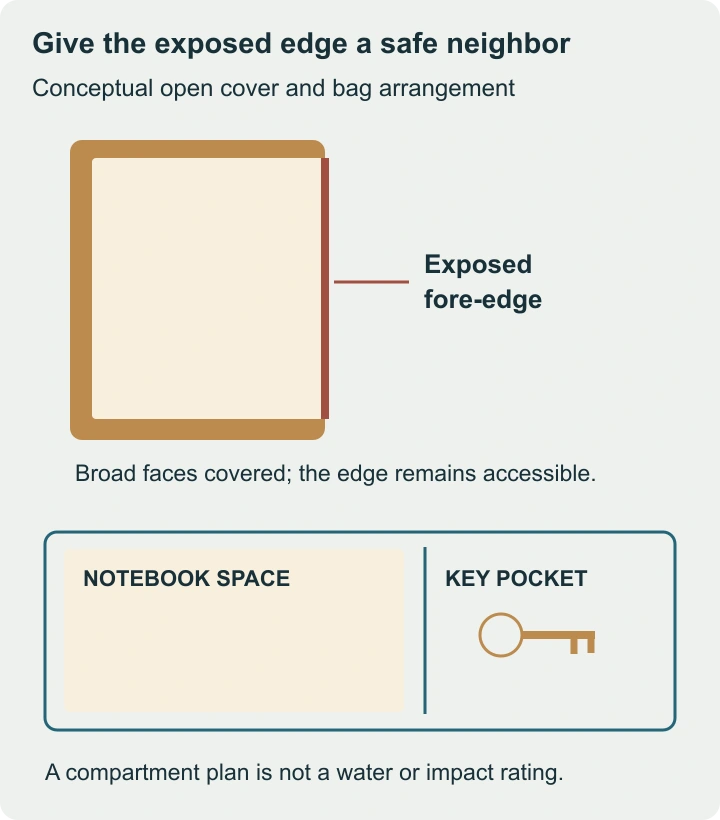
Imagine a bag with one large main compartment. An open-sided notebook sits beside keys, a charging plug and a water bottle. The cover’s broad surfaces may be protected, but the fore-edge can still meet the hard objects. The bottle adds a separate liquid-exposure question that the cover does not answer.
| Arrangement | Problem left unresolved | More useful adjustment |
|---|---|---|
| Notebook and keys loose together | Keys can reach the exposed edge | Give keys a retained pocket away from the book |
| Notebook wedged tightly under a charger | Pressure and awkward removal | Separate the hard accessory and preserve an exit path |
| Loose papers tucked between pages | Paper can migrate or fall out | Use a suitable document pocket or separate folder |
| Bottle in the same unprotected space | The cover provides no established leak barrier | Plan liquid separation appropriate to the bag and contents |
The better arrangement does not necessarily need more padding everywhere. It needs the right separation at the relevant contact points. A dedicated compartment that is too narrow, however, may make removal harder or bend corners. Test the finished arrangement instead of counting pockets as automatic improvements.
Observe the actual exposed edges
Look at the closed notebook from the top, bottom and open side. Identify which parts of the page block project, whether the leather extends beyond them and how the object sits when returned to the bag. A product photograph from the front does not show all of these relationships.
Do not describe a projection as a defect without understanding the design. Some open covers deliberately leave edges accessible. The question is whether that exposure is compatible with the intended environment. A notebook used at a clean desk and one carried with tools ask different things of the same design.
Neither the word “leather” nor an apparently close fit establishes water resistance, dust sealing or impact protection. If a specific protection claim matters, look for evidence for the complete product and its use conditions. A material description alone is not that evidence.
Keep quick access gentle
Retrieve the notebook by supporting the object, not by pulling on a loose page, ribbon or projecting cover corner. Library of Congress handling guidance cautions against stressing book structures and forcing bindings. The purpose of an open design is to simplify access, not to turn exposed parts into handles.
When writing, arrange the outer cover so it does not pull on the notebook’s boards. If a large flap or retention pocket creates a ridge under the hand, assess whether a different orientation or construction is preferable. Avoid repeatedly folding a stiff section into a sharp new crease merely to make it disappear.
When an open side is a sensible tradeoff
An open-sided cover is a plausible choice when the notebook stays seated, access is frequent and the carrying arrangement protects the exposed edges. It is less convincing when the user expects the cover itself to contain loose papers or isolate the notebook from everything in a mixed bag.
Compare the same notebook in the snap-closure guide and the wrap-and-tie guide if retaining a closure matters more than eliminating a step. For broader protection options, the cover, sleeve and storage-box comparison separates use during writing from transport and storage.
A good decision identifies the exposed part and assigns its protection somewhere in the system. Once that is explicit, the absence of a fastener becomes an intentional feature rather than an overlooked expectation.