Fit a large notebook cover without restricting the binding
A large notebook cover has two jobs that can conflict: keeping the notebook seated and allowing the binding to move naturally. A cover can look correct when closed yet pull at the boards when opened, obstruct the rear pocket or leave a wrist resting on a ridge. Closed dimensions are therefore only the first part of the fit.
This guide concentrates on the writing and opening behavior of a removable leather cover around a large notebook. It does not claim that the historical Renaissance Art product at this address is currently available or compatible with a particular modern refill. Use the actual notebook and cover for the checks below.
Establish how the notebook behaves without the outer cover
- Put the notebook on the surface where you normally write.
- Open it near the beginning, near the middle and near the end without forcing it flat.
- Notice whether it stays open, where the pages rise near the spine and how much support each side needs.
This baseline is important. If a notebook already resists lying flat, the removable cover has not necessarily created that resistance. If the notebook opens comfortably on its own but becomes difficult after insertion, the outer cover or its installation deserves attention.
The Library of Congress advises against forcing a book completely flat and recommends supporting covers where appropriate. Applied here, the principle is simple: assess fit within the binding’s normal movement. Do not use pressure on the spine to make a poor combination look successful.
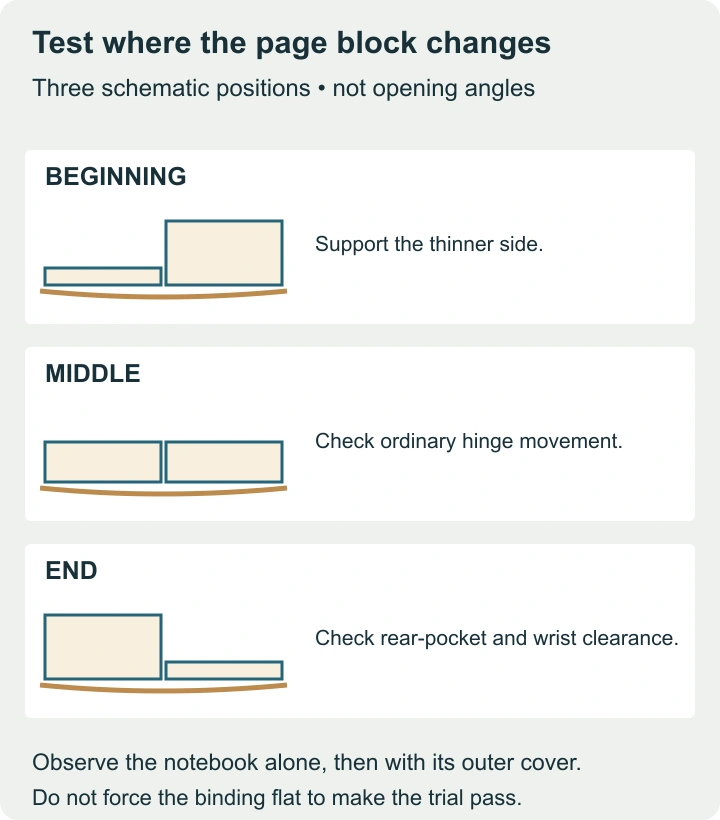
Check three positions, not just the centre spread
| Position | What changes | What to observe |
|---|---|---|
| Near the beginning | Most pages remain on one side | Whether the thinner side is supported and the hand clears the outer cover |
| Near the middle | The page blocks are more balanced | Whether the spine and retention pockets allow ordinary opening |
| Near the end | The balance reverses | Whether the rear-board pocket, elastic or pen loop creates a new obstruction |
Write several ordinary lines in each position, including the line nearest the inner margin that you would realistically use. A comfortable centre spread does not settle the beginning or end of the book. Repeat with your usual writing hand and pen rather than copying someone else’s demonstration.
If the desk is small, include that condition. A broad flap may be harmless on a dining table but occupy the space needed for a keyboard or reference document. The useful question is whether the whole arrangement fits the task, not whether it can be photographed lying open.
Insert the boards without using the book as a stretching tool
Inspect the retention pockets before insertion. Identify which parts are meant to receive the notebook boards and whether the cover has a particular sequence specified by its maker. A stiff board should not need to be sharply bent to pass a seam or narrow opening.
Seat the notebook gradually and check that both sides are aligned. If one board is deeper in its pocket than the other, the closed appearance may hide a twist. Stop if insertion requires force, the notebook bows or the material begins to distort around a seam.
Do not assume that use will solve a dimensional mismatch. Leather may change with handling, but the amount and consequences depend on the construction and material. “It will stretch” is not a substitute for a demonstrated fit, especially when the notebook itself is being used to apply the load.
A worked observation: fit changes after the notebook is loaded
Consider a fictional notebook measured at 212 × 134 × 18 mm when empty of loose inserts. With the cards and folded papers its owner ordinarily keeps, the closed thickness becomes 24 mm. The increase is 6 mm, or one-third of the original thickness. These figures illustrate a change in the object being fitted; they are not a recommended allowance.
| Condition | Observation | Interpretation |
|---|---|---|
| Notebook alone | Both boards seat and the cover closes normally | Fit is plausible for the 18 mm condition only |
| Ordinary contents added | The flap reaches but the front board bows | Closure reach alone does not establish acceptable fit |
| Loose papers moved to a separate folder | The board returns to its ordinary position | The inserted load contributed to the problem |
| Open near the rear | The pocket cannot be opened as far as needed | Access may remain unsuitable even if closure improves |
In this example, the sensible next step is to choose which contents must remain inside. If the extra papers are essential, assess a different combination. If they are temporary receipts, storing them elsewhere may preserve both writing comfort and retrieval. Tightening the closure would conceal the symptom without addressing it.
Preserve access to the features you actually use
A rear document pocket, elastic closure, ribbon and pen loop can occupy overlapping space. Test each with the notebook installed. Open the rear pocket far enough for the document you intend to remove; do not count it as accessible merely because its top edge remains visible.
Moleskine’s Classic hard-cover description includes an expandable rear pocket, elastic closure and ribbon marker. Those are useful features to check on the actual edition, not evidence that every outer cover accommodates them. Leave the original elastic in the arrangement specified or supported by the cover design, without trapping it across a writing surface.
For a pen loop, use the pen with its cap or clip in the normal position. Check where it lies when the notebook closes and whether the pen becomes the first object pressed against the page edge. A loop that retains a pen can still place it inconveniently.
Separate writing support from a demand for flatness
If a board is unsupported, a clean, suitable support beside it may make writing easier without changing the binding. This is different from pressing the spine down. Try the least intrusive arrangement that supports the object in its natural opening range.
For a modern notebook intended for frequent writing, decide whether the setup is practical enough to repeat. If every short entry requires rebuilding a stack of supports, a different notebook format may better suit the task. For a fragile or significant book, preservation takes priority over adapting it to a daily-carry workflow.
Record the result so a replacement refill can be checked
Keep the notebook’s exact model, closed dimensions, ordinary loaded thickness and the result of the three-position trial. Add a note about which features remained usable. A photograph of the closed object alone will not preserve those details.
When replacing the notebook, repeat the checks even if the size label is unchanged. Page count, board construction and pocket contents can alter the working combination. For the dimensional comparison itself, use the notebook-size guide; for a closure comparison, use the overview of cover types.
A successful large cover lets the notebook close in its ordinary shape, open without new strain and support the writing you actually do. The strongest evidence is that complete sequence with the intended refill—not the word “large,” the presence of a fastening or a promise that the leather will eventually adapt.