Read notebook sizes correctly before choosing a removable cover
A notebook size label is an identifier, not a complete compatibility specification. A removable cover must accommodate the actual closed object, its thickness and the movement needed to insert and open it. The paper format, outside board dimensions and usable space inside the outer cover are related measurements, but they are not the same measurement.
The most useful approach is to create a small dimension record and then verify the combination physically. This guide explains the record and the arithmetic. It does not provide a leather-cutting pattern or a universal allowance that guarantees fit.
Use manufacturer labels to identify a family, then measure the object
Moleskine’s Classic Notebook product page lists Pocket at 9 × 14 cm, Large at 13 × 21 cm and XL at 19 × 25 cm. Those nominal formats help distinguish the sizes. They do not establish the thickness of every edition or the inside dimensions of an unrelated leather cover.
| Label on the cited Classic range | Nominal width × height | Still establish for the actual notebook |
|---|---|---|
| 90 × 140 mm | Outside board size, thickness and projections | |
| Large | 130 × 210 mm | The same dimensions, including ordinary contents |
| XL | 190 × 250 mm | Insertion opening and working movement in the cover |
A different manufacturer may use the same word for a different format. Even within a range, a hard cover, soft cover, expanded page block or different binding can change the object you must fit. Record the exact product identity instead of retaining only “large notebook” on a shopping list.
Give each measurement an unambiguous name
Measure the notebook closed and resting in its normal shape. For this guide,
- height runs from top to bottom along the spine direction;
- width runs from spine to fore-edge across the front;
- thickness runs through the closed book.
Include the outside boards rather than measuring only a sheet of paper.
Use one unit consistently. Millimetres are convenient for small differences. Converting 13 cm to 130 mm does not create additional measurement precision, and writing a ruler measurement as 134.000 mm does not make it more exact.
Keep permanent and removable projections separate. A fitted pen, elastic, tab or filled rear pocket may affect clearance, but each affects a different location. Record where the projection occurs instead of enlarging every dimension by an arbitrary amount.
A positive dimensional difference is only an initial screen
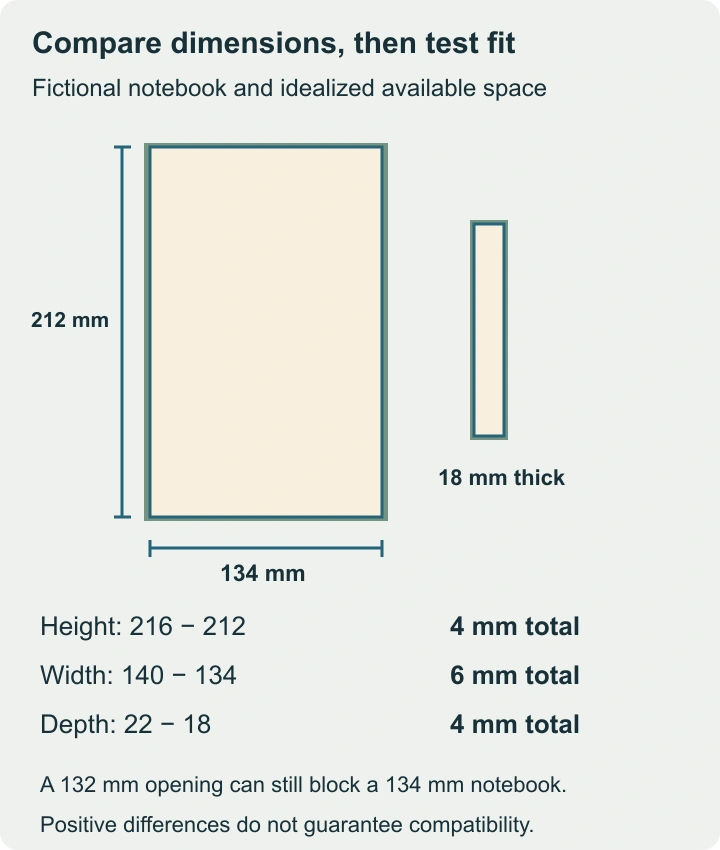
Consider a fictional notebook measured at 212 mm high, 134 mm wide and 18 mm thick. Suppose a candidate’s relevant available space is measured as 216 × 140 × 22 mm in the same orientation. This simplified rectangular comparison produces differences of 4, 6 and 4 mm.
| Dimension | Notebook | Available space | Total difference |
|---|---|---|---|
| Height | 212 mm | 216 mm | 4 mm |
| Width | 134 mm | 140 mm | 6 mm |
| Thickness | 18 mm | 22 mm | 4 mm |
If the object were centred in an ideal rigid rectangular space, a 4 mm total height difference would mean 2 mm at each end. It would not mean 4 mm at each end. Real covers may not centre the notebook, and seams, curves and flexible walls make the ideal model incomplete.
Now suppose the actual insertion opening is only 132 mm wide in the required orientation. The notebook’s 134 mm width exceeds that opening even though the nominal interior is 140 mm wide. The object cannot be assumed to enter by the intended straight path. Tilting, bending or forcing it is not a valid substitute for checking the design.
Do not spend a small clearance before accounting for uncertainty
Imagine that the notebook width is recorded as 134 ± 1 mm and the available width as 140 ± 1 mm. Treat these as hypothetical bounds for the example, not statistical confidence intervals. The conservative dimensional difference is 139 − 135 = 4 mm. The largest difference within those bounds is 141 − 133 = 8 mm.
The point is not to require specialist instruments for an ordinary notebook. It is to avoid treating a tiny apparent surplus as exact. Check where the ruler touches, whether the object is compressed and whether the seller is reporting exterior dimensions or usable interior space.
For a handmade or flexible cover, ask how its stated dimension was measured. A flattened outer measurement can differ from the space available when a book is installed. A seller’s tolerance statement should be tied to the relevant dimension, not assumed to apply equally to every seam and opening.
Measure the condition you intend to carry
A notebook with a rear pocket full of papers is a different fitting condition from the same notebook with an empty pocket. Measure ordinary contents, then decide whether they are part of the requirement. Do not use a compressed measurement achieved by squeezing the covers together.
Separate page-block thickness from a local bulge. A stack of cards in one corner can tilt the closed object without changing the entire spine uniformly. In the dimension record, note the location and what creates it. The remedy may be a different storage arrangement rather than a uniformly larger cover.
Page count alone does not reliably convert into thickness. Paper, boards, binding and inserts all contribute. Two notebooks with the same advertised number of pages should be measured independently if compatibility depends on a close fit.
Send a brief that another person can reproduce
A useful fitting brief identifies the notebook, dimensions, ordinary contents and required features. For example: “Closed outside dimensions approximately 212 × 134 × 18 mm; hard boards; rear pocket used for two folded sheets; elastic must remain usable; no pen attached.” These are example details, not a real product recommendation.
Include photographs showing the measurement orientation if there is any ambiguity. Keep the ruler in the same plane as the measured feature and avoid using perspective as evidence of a precise dimension. Do not send only a diagonal screen-style size or a photograph without a scale.
For the cover, ask for the usable opening, compatible notebook range and the conditions under which compatibility has been checked. “Designed for this exact edition” is more informative than “fits most large notebooks,” though the actual loaded condition still matters.
Finish with insertion, opening and removal
A dimensional screen can reject an obvious mismatch; it cannot establish every aspect of a successful fit. Insert the notebook normally, confirm that its boards remain in their ordinary shape, open it through its comfortable range and remove it without dragging vulnerable edges.
The large-notebook working-fit guide develops the three-position writing check. The book-measurement guide covers a broader range of removable-cover projects. Use the measurement record to make those checks reproducible, not to replace them.
The final result should be a clear statement about one combination under known conditions: this notebook, this cover, these contents and this ordinary use. That is a stronger basis for a decision than a familiar size word or a positive number produced by an oversimplified formula.