Book of Shadows 11 × 14: the record, dimensions and working use
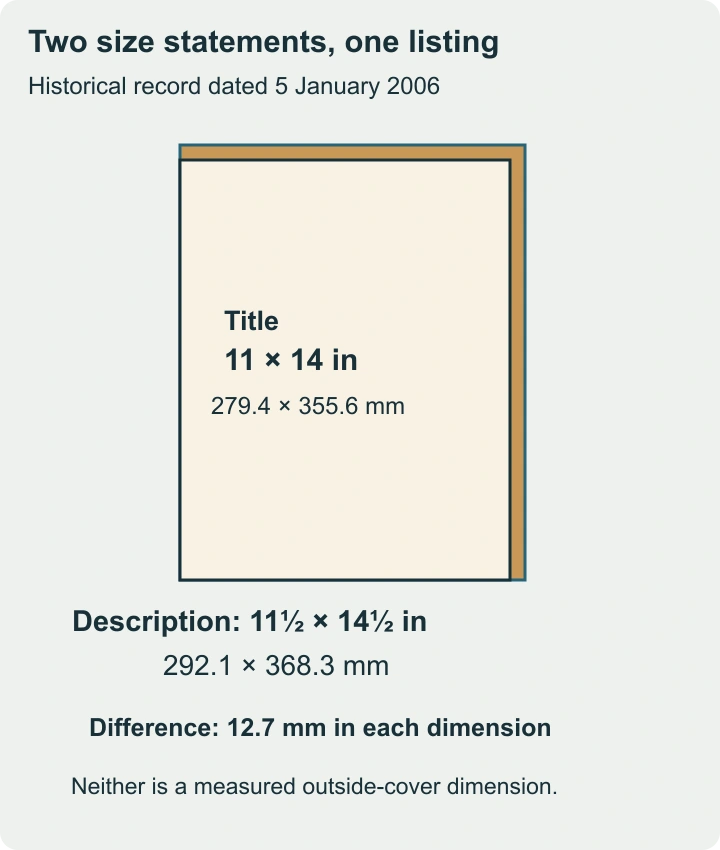
The saved Renaissance Art listing names this journal “Book of Shadows 11 X 14,” but its description gives the pages as 11½ × 14½ inches. That discrepancy should remain visible. A buyer, collector or researcher should not silently replace one figure with the other or treat either as a measured outside-cover dimension.
This page explains what the historical record establishes and how to evaluate a large working journal of this kind. It does not offer current stock, reproduce a verified sewing pattern or claim that the product’s name gives the book supernatural properties.
Read the 2006 record precisely
The saved first-party snapshot is dated 5 January 2006. Its description specifies 288 hand-torn, acid-free pages and lists wrap-and-tie and double-strap closure choices. These are the seller’s statements in that record, not measurements or material tests performed for this guide.
| Field | What the record says | What remains unestablished |
|---|---|---|
| Product name | Book of Shadows 11 X 14. | Whether the rounded title refers to a nominal size or another convention. |
| Page dimensions in the body | 11½ × 14½ inches. | Outside-cover dimensions and the reason for the title discrepancy. |
| Extent | 288 pages. | A verified count of any particular surviving copy. |
| Paper description | Hand-torn and acid-free. | Weight, fibre composition, surface treatment and compatibility with specific media. |
| Closure | Wrap-and-tie or double strap. | Present availability or the configuration of an individual example. |
The record does not establish Coptic binding. Visible thread or folded sections in a photograph would not by themselves reveal every attachment in a binding. Describe observed features and ask for construction evidence rather than converting an attractive visual impression into a technical claim.
Translate the size difference into a practical question
Using 25.4 mm per inch, 11 × 14 inches converts to 279.4 × 355.6 mm. The body’s 11½ × 14½ inches converts to 292.1 × 368.3 mm. Each dimension differs by 12.7 mm. The conversion is exact arithmetic; it does not resolve which size describes a particular object.
For desk planning, two 11½-inch-wide pages placed flat side by side would span 23 inches, or 584.2 mm, before allowing for cover projections and the way the actual binding opens. That is an idealized paper spread, not the journal’s measured footprint. Make a paper mock-up and place it on the intended desk alongside your tools and reference material.
A page that fits a desk may still leave no room for the writing hand or a paint palette. Check the full working arrangement, including lighting and how the book is supported near its first and last pages. For carrying, measure the complete closed object and its enclosure rather than ordering a bag from the historical page dimensions.
Decide what will go on the pages
A large journal can hold handwriting, diagrams, copied texts, sketches or mixed entries. The right paper depends on the actual media. A historical “acid-free” description does not establish that it will tolerate a wet wash, repeated erasing or a particular ink without problems.
| Intended use | Test | Observation to retain |
|---|---|---|
| Pen and ink | Normal writing, slow strokes and a small filled area. | Line spreading, penetration, show-through and handling transfer. |
| Pencil | Light construction lines, darker shading and the normal eraser. | Surface change and whether the revised marks remain usable. |
| Water-based colour | A small representative application on a verified sample. | Surface response, distortion and behaviour after drying. |
| Added papers or objects | A mock-up of the planned thickness outside the book. | Whether the project needs a construction designed for expansion. |
Do not use an original completed page as a test surface. A loose sample can help with media selection but cannot demonstrate how moisture or added thickness will affect the bound book. If the original stock cannot be identified, record that limitation instead of assuming that a visually similar sheet is equivalent.
Paper manufacturers distinguish stocks intended for drawing, watercolour and mixed media. Those categories are a reason to investigate suitability, not a way to assign a stock to this historical journal. Choose a purpose-made book for a technique when that is more appropriate than adapting an uncertain one.
Make a page plan before starting a long project
If a journal is confirmed to have 288 available page surfaces, a hypothetical allocation could reserve 12 for title and contents, 8 for tests and working conventions, and 28 as spare capacity. That leaves 240 surfaces for the main project. At two surfaces per entry, the arithmetic permits 120 entries under those assumptions.
Do not confuse surfaces with leaves. If only one side of each leaf is suitable for the chosen medium, the available working capacity changes. Likewise, a design that requires facing pages needs an opening-by-opening plan; two unused surfaces elsewhere are not automatically a usable spread.
For a project of copied texts and commentary, consider one entry containing a source identifier, the copied passage, your own interpretation and the date. Keep quotations distinguishable from your writing. For drawings, reserve space for a title, medium and a short note about what the image records. These details help a later reader understand the work without having to infer its origin.
Evaluate the individual binding without forcing it
Place the book on a clean, supportive surface and open it within its natural range. Examine several positions rather than judging the whole book from the middle. Note lifting boards, loose sections, cracking joints, previous repairs and any change in resistance as pages turn.
The Canadian Conservation Institute advises respecting a book’s opening limits and supporting it appropriately. For a fragile example, a cradle or suitable support may be needed. A book that resists opening should not be pressed flat simply because a large drawing would be easier that way.
Record what you actually observe: “the front joint opens reluctantly” or “a section is loose near the back.” Avoid diagnosing a hidden construction failure from a photograph. For a valuable or deteriorating volume, obtain advice from a qualified book conservator before attempting repairs or fitting a tight new cover.
Document a surviving example as an individual object
- Photograph the outside, spine, closures, title or identifying marks, and representative openings without forcing the book.
- Measure the closed exterior and, only where safe, a page.
- Record whether a measurement includes torn edges or a projecting cover flap.
- Keep the date and method with the photographs.
A useful catalogue note separates three kinds of information: what the historical seller said, what you observed and what remains uncertain. For example, the listing may mention two closure options while the surviving object has one strap missing. That condition does not rewrite the historical offer, and the historical offer does not prove the missing part’s exact design.
If the leather is powdery, cracking or transferring material, do not apply a generic conditioner to make the book presentable for photographs. Conservation guidance for old bindings is different from routine care for a modern leather bag. Suitable housing and careful handling may be more appropriate than cosmetic treatment.
Decide whether this format serves the work
Before using a large journal, complete a representative session on a mock-up of comparable size. Include a long paragraph, a drawing, a correction and the annotations you expect to add. Check whether the format helps organize the material or merely encourages longer lines than are comfortable to write and reread.
If the project involves extensive wet media or thick collage, a book designed for that purpose may be the better working object. If the intention is careful handwriting and spacious diagrams, the large format may be useful once the actual paper and opening have been assessed. Neither conclusion follows from the name alone.
Keep any finished volume identifiable through a title, date range and contents record. The historical page supplies an identity and a set of seller descriptions. The suitability of an individual book depends on its measured dimensions, materials, condition and the work you intend to place inside it.