Choose a compact book bag by opening, load and access
A compact book bag succeeds when you can put the complete kit in, close it without pressure and remove the book without unpacking everything else. Its capacity in litres is only a rough starting point. A rigid book must pass through an opening of a particular shape, and keys, a glasses case and a water bottle cannot all occupy the same spare corner.
Build the comparison around the largest book you regularly carry in its normal cover or enclosure. This is a practical fitting guide; it does not establish the dimensions, protection rating or present-day availability of a historical Renaissance Art bag.
Lay out the actual daily kit
Put the book and everyday objects on a table. Include the things that are easy to forget in an attractive packing photograph: a bulky key ring, the glasses case, medication you need to carry, a charger or a folded document. Mark which items are occasional so they do not silently become permanent requirements.
| Item | Example measurement or condition | Placement requirement |
|---|---|---|
| Covered book | 230 × 160 × 35 mm; rigid boards. | A clear route through the opening and support without bending. |
| Glasses case | 160 × 65 × 40 mm; hard shell. | Accessible without pressing against the book’s opening edge. |
| Keys | Irregular metal objects. | A separate retained location away from exposed paper and screens. |
| Phone | Measured with its usual case. | Reachable without removing the book. |
| Occasional document | Must remain unfolded. | A dedicated flat route or a decision to carry it separately. |
Measurements in this example are invented. Use the dimensions of your own objects and keep their orientation clear. “230 × 160” is incomplete unless the maker knows which side is vertical during insertion and where the closure sits.
The opening can defeat an otherwise roomy bag
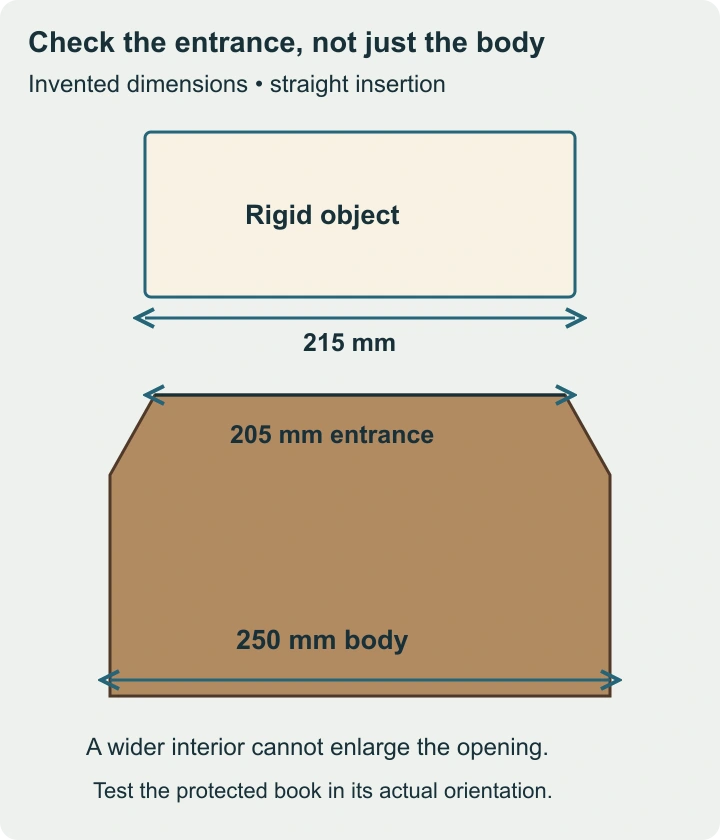
Suppose a bag has a 250 mm-wide interior, but its zip and end tabs leave a clear entrance of 205 mm. A rigid object 215 mm wide cannot pass straight through in that orientation. The wider body does not change the entrance. Turning the object may help, but only if there is enough depth and movement inside; it is not a guaranteed workaround.
Ask for the usable opening with the closure in its normal fully open position. Also ask about the narrowest point along the insertion route. A flap may lift out of the way while a zip end, lining seam or internal divider remains in the path.
A cardboard dummy is useful for a first check. Reproduce the protected book’s width, height and thickness rather than using a single flat rectangle. Mark the top and the edge that enters first. Do not treat a successful dummy test as evidence of load strength or comfort: its job is to expose obvious geometric problems.
Why the litre figure cannot settle fit
A simple rectangular space of 250 × 220 × 100 mm has a calculated volume of 5,500,000 mm³, or 5.5 litres. That is a mathematical box, not a measured capacity claim for a real bag. A curved base, seams, padding and internal pockets reduce or redistribute its usable space.
Two idealized spaces can have the same volume but accept different rigid objects. A 250 × 220 × 100 mm box and a 200 × 275 × 100 mm box both total 5.5 litres. A 230 mm-wide object cannot lie across the 200 mm dimension in the same orientation. For a book bag, the arrangement of dimensions matters as much as their product.
Use litres to compare general bulk, then use dimensions and a loaded trial to establish fit. A capacity label is particularly weak evidence when the bag is tapered or has a narrow top.
Make a packing plan that survives ordinary use
- Place the book against a relatively flat supported part of the bag where it will not have to bend around hard objects.
- Give keys their own retained place.
- Check that a glasses case or charger cannot migrate into a position that presses against the book’s page edges when the bag tilts.
If you carry a drink, consider whether it belongs in this small bag at all. A tightly packed bottle can consume the space needed to retrieve the book. A separate bottle compartment or separate carrying arrangement may be more practical, and a leather exterior is not evidence that the contents are protected from a leak.
Rehearse the most frequent action. With the bag otherwise packed, remove the book, open it briefly and put it back. Then retrieve the phone. If either action requires putting several loose objects on a café table, the organization may be wrong even though everything technically fits.
| What happens | Likely issue to investigate | Possible response |
|---|---|---|
| Keys fall into the space left by the book. | Small items are unrestrained. | A suitable internal pocket or key attachment. |
| The book catches while being removed. | Restricted opening, projecting cover or a loaded pocket in its path. | Change orientation or confirm a larger clear route. |
| The closure reaches only when the contents are compressed. | The loaded profile exceeds the practical space. | Reduce the kit or choose a different construction. |
| The phone disappears beneath the book. | Its location does not match frequent access. | A designated accessible pocket with suitable retention. |
Try carrying the load, not an empty bag
Weigh the assembled kit and the bag separately if possible. In an invented example, a 0.75 kg bag and 1.45 kg of contents produce a 2.20 kg carried load. Reducing the bag by 0.15 kg would bring it to 2.05 kg; removing a 0.40 kg unnecessary item would bring the original arrangement to 1.80 kg. These figures illustrate where weight comes from, not a recommended carrying limit.
Adjust the strap, then try standing, walking, sitting and reaching for the book in a safe setting. Notice whether the bag swings, a rigid corner presses into you or the strap position obstructs access. Check the handle too if you regularly switch from shoulder to hand carrying.
Comfort depends on the person, duration and load. A short trial can reveal an immediate mismatch, but cannot certify comfort for a full journey. If discomfort develops, change the load or carrying arrangement rather than using an arbitrary weight percentage as a promise that it ought to feel fine.
Ask for evidence about the protection you need
Scratch separation, rain protection and impact protection are different requirements. A soft partition may separate objects while offering little cushioning. A flap may cover the opening while leaving gaps at the sides. Ask what the particular construction is intended to do.
If the book is valuable or vulnerable, choose a suitable separate enclosure and include it in the fitting measurements. Do not assume that a leather bag is itself an archival enclosure. For ordinary everyday books, the immediate priorities are keeping the book supported, avoiding abrasion and preventing foreseeable contact with wet or hard objects.
For a used bag, inspect seams, strap attachments, hardware, lining and any sharp edges before loading it. Note repairs rather than assuming that an attractive surface means the structure is sound. Do not test an unknown load limit by filling the bag until a component fails.
Write a brief with a pass condition
Instead of “a small bag for books,” write: “My covered book is 230 × 160 × 35 mm, carried upright. It must enter without flexing and be removable with my glasses case and phone still packed. Keys need a retained place away from the page edges. Please confirm the clear opening and usable interior after pockets and lining are fitted.” Replace those example measurements with your own.
At handover or during the return window, repeat that exact trial. Photograph the approved arrangement if it will help you pack consistently. If an occasional extra object makes the bag impractical, decide whether to carry that item separately or choose a slightly larger model. Compactness is valuable when it reduces unnecessary bulk while preserving the actions you need every day.